xUSD
xUSD Overview
xUSD is an algorithmic stablecoin deployed on the CrossFi Chain that is designed to maintain a 1:1 peg to the U.S. Dollar. Issued through the CrossFi xApp DeFi platform, xUSD is backed by a robust and transparent collateralization mechanism, ensuring both stability and liquidity in a fully decentralized environment.
xUSD Token
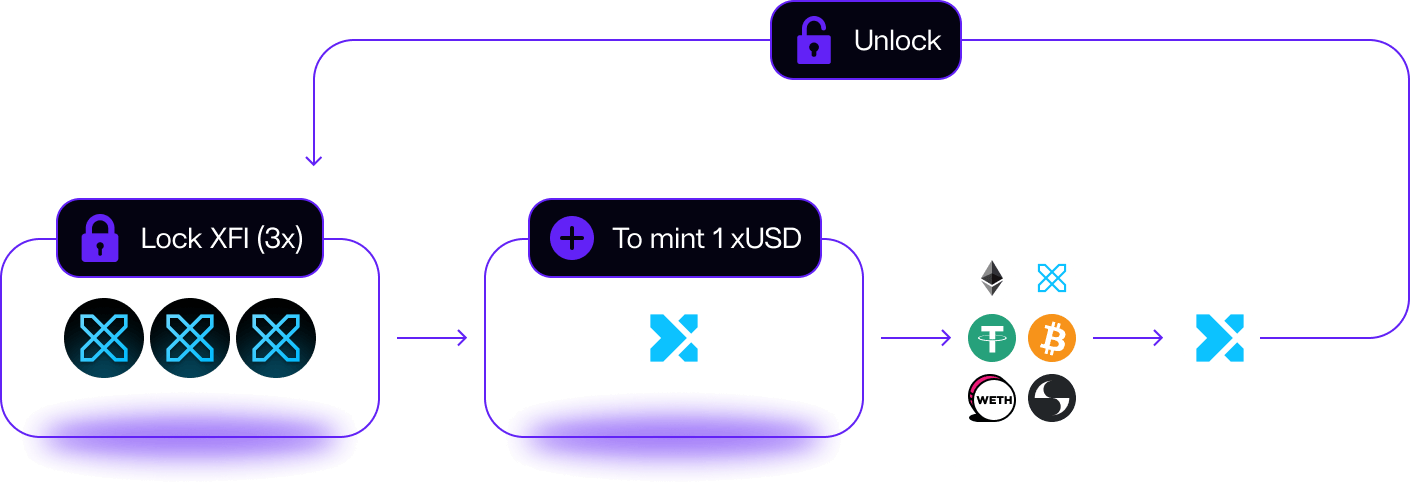
xUSD is a CrossFi-native stablecoin that maintains its peg to the U.S. Dollar through a carefully engineered collateral system. To mint xUSD, users deposit their assets—primarily the native coin XFI—as collateral. For example, to mint 100 xUSD, a user must lock a minimum of $375 worth of XFI, reflecting a collateralization ratio of 375%. This high collateralization ensures that there is a significant buffer against market volatility.
If the value of XFI (the collateral) falls below a healthy threshold—specifically, when it dips to 150% of the minted xUSD—the position is automatically liquidated. In such an event, the collateral is used to cover the outstanding xUSD debt and associated liquidation fees, thus preserving the stability of the overall system.
How to Use xUSD
xUSD is designed not only as a stable store of value but also as a versatile tool within the CrossFi ecosystem. It plays a central role in various blockchain applications and DeFi protocols. Here are some of the primary use cases:
- Investments in Other Crypto Assets:
xUSD can be used to invest in a diverse range of crypto assets without exposure to undue volatility. - DeFi Participation:
xUSD is integrated across several key protocols on the CrossFi Chain:- Staking: Users can stake xUSD within platforms like xApp to earn additional incentives.
- Liquidity Provision: xUSD is essential in liquidity pools such as xSwap, helping maintain overall ecosystem fluidity.
- Lending: Platforms like PhoLend allow users to lend or borrow xUSD, further expanding its utility.
- Future Applications: xAssets platform will also incorporate xUSD, unlocking more advanced DeFi opportunities.
Additionally, xUSD provides a strategic advantage for XFI holders. Instead of selling XFI to make a purchase or trade an asset, users can lock a portion of their XFI as collateral to mint xUSD. After completing their transactions, they can repay the xUSD and retain their XFI balance—benefiting from potential appreciation while preserving their stake in the network.
Collateralization Mechanism
xUSD is secured by a high collateralization model with a 1:3.75 ratio (375%). This means that every 1 xUSD is backed by assets totaling 3.75 times its value. Key aspects of the collateral system include:
- High Overcollateralization:
A 375% collateralization requirement protects xUSD from volatility and inflation, offering enhanced stability compared to many other stablecoins. - Automated Liquidation:
Should the collateral value (XFI) drop below the required healthy threshold (150% of the minted xUSD), an automated liquidation process is triggered. This process uses the locked XFI to cover the outstanding xUSD debt along with liquidation penalties (15% protocol fee + 5% liquidator bonus). - Transparent and Decentralized:
All collateral reserves are secured and verified by smart contracts on the CrossFi Chain, ensuring full transparency and eliminating risks associated with third-party intervention or asset freezing.
xUSD Compared to USDC and USDT
xUSD distinguishes itself from centralized stablecoins by being 100% backed by cryptocurrency assets (primarily XFI) and by operating in a completely decentralized manner. Consider the following comparison:
| xUSD | USDT | USDC | |
|---|---|---|---|
| Regulatory Stance | Not regulated by design (fully decentralized) | Issued with some regulatory oversight, but centralized in nature | Issued by regulated financial institutions |
| Risk of Blocking | No risk of asset blocking or freezing | Subject to potential asset blocking due to centralized control | Assets may be subject to blocking by the issuing entity |
| Reserve Mechanism | Fully transparent reserves secured by smart contracts (cryptocurrency-based) | Relies on fiat reserves with less transparency | Fully backed by fiat dollars, but requires reliance on centralized audits |
This comparison highlights xUSD's decentralized and transparent nature, which mitigates risks commonly associated with centralized stablecoins.
What Is an Algorithmic Stablecoin?
Algorithmic stablecoins, such as xUSD, maintain their peg to a fiat currency through automated mechanisms—using algorithms, smart contracts, and collateralization processes. They are designed to be highly liquid and serve as effective trading tools within the DeFi space. Unlike centralized stablecoins (e.g., USDT and USDC), which depend on fiat reserves managed by a single issuer, algorithmic stablecoins offer:
- Decentralized Control:
The user retains full control over assets without third-party intervention. - Robust Collateralization:
A high collateralization ratio provides a significant buffer against market volatility. - Transparent Operations:
All aspects of the stablecoin's reserves and operations are verifiable on-chain via smart contracts.
Key Advantages of xUSD
- Decentralized Stability:
xUSD operates on the CrossFi Chain, ensuring that funds remain in the direct control of users. The decentralized architecture eliminates risks related to centralized management or asset freezing. - High Liquidity and Flexibility:
Integrated across various DeFi platforms, xUSD is a key component of liquidity pools, enabling seamless trading, lending, and staking operations. - Collateralized Security:
With a collateralization ratio of 1:3.75 (375%) and automated liquidation mechanisms at 150%, xUSD is designed to remain stable even during market fluctuations. - Transparent and Trustworthy:
Fully secured by smart contracts, the collateral reserves for xUSD are fully transparent, providing an additional layer of security and reliability for users. - Future-Proof Design:
Plans to expand the variety of collateral assets may further enhance the stability and utility of xUSD, ensuring that it remains at the forefront of decentralized finance solutions.
Technical Framework & Risk Parameters
Liquidation Mechanism
xUSD maintains system stability through an automated liquidation system that protects against under-collateralized positions.
Liquidation Formulas
Health Factor Calculation:
Minimum Health Factor to Borrow:
Current System Parameters:
- Collateral Ratio: 375% (3.75:1)
- Liquidation Ratio: 150% (1.5:1)
- Minimum Health Factor: 2.5
- Liquidation Threshold: Health Factor ≤ 1.0
When Health Factor drops to 1.0 or below, the position becomes eligible for liquidation by authorized liquidators.
Liquidation Penalties & Distribution
When liquidation occurs, fees are distributed as follows:
💰 Liquidation Bonus
5% - Paid to the liquidator as an incentive for maintaining protocol stability
🏛️ Protocol Fee
15% - Collected by the protocol treasury to support ecosystem development
Liquidation Capacity:
- Liquidators can repay up to 50% of the user's debt in a single transaction
- This partial liquidation helps restore positions to healthy collateralization ratios
Role of Liquidators
Liquidator Mechanics:
- Position Monitoring - Liquidators continuously monitor positions for Health Factor ≤ 1.0
- Liquidation Execution - Repay up to 50% of debt in XUSD
- Reward Collection - Receive collateral value + 5% bonus
Liquidator Incentives:
- Immediate profit: 5% bonus on liquidated collateral
- Risk-free opportunity: Guaranteed return when HF ≤ 1.0
- Network stability: Support protocol health while earning rewards
Example Scenario:
Initial Position:
- Alice deposits $450 XFI and mints 100 XUSD (HF = 3.0)
- XFI price drops, collateral value falls to $150 (HF = 1.0)
Liquidation Event:
- Bob (liquidator) repays 50 XUSD (50% of debt)
- Bob receives: 2.50 bonus = $52.50 worth of XFI
- Protocol collects: $7.50 fee (15%)
Post-Liquidation:
- Alice's remaining debt: 50 XUSD
- Alice's remaining collateral: $90 worth of XFI
- New Health Factor: 1.2 (position restored)
Oracle System
xUSD relies on decentralized price feeds to ensure accurate collateral valuation and liquidation triggers.
Oracle Providers:
🔷 Primary: DIA Oracle
- Main price feed source
- Update Frequency: 120 seconds (2 minutes)
- High reliability and accuracy
🔶 Fallback: Stork Oracle
- Secondary price feed source
- Automatic failover mechanism
- Ensures continuous price availability
Fallback Mechanism:
- If primary oracle (DIA) fails to respond, the system automatically switches to Stork Oracle
- This dual-oracle design prevents price feed failures from affecting protocol operations
MEV & Front-Running Protection
xUSD implements robust protection mechanisms against MEV (Maximal Extractable Value) attacks and front-running:
Lockup Period Implementation:
- After each oracle price update, a lockup period is enforced
- This delay prevents traders from exploiting price changes before liquidations execute
- Eliminates front-running opportunities on oracle-triggered liquidations
Benefits:
- Fair liquidation process - All liquidators have equal opportunity
- User protection - Prevents predatory liquidation timing
- System stability - Reduces market manipulation risks
Governance Parameters
xUSD currently operates under owner-controlled governance. DAO governance is not yet activated.
Adjustable Parameters:
| Parameter | Current Value | Controlled By | Description |
|---|---|---|---|
| Collateral Ratio | 375% | Protocol Owners | Minimum collateral required to mint XUSD |
| Liquidation Ratio | 150% | Protocol Owners | Threshold at which liquidation is triggered |
| Liquidation Penalty | 15% | Protocol Owners | Fee collected by protocol during liquidation |
| Liquidation Bonus | 5% | Protocol Owners | Reward paid to liquidators |
| Oracle Update Frequency | 120 seconds | Protocol Owners | How often price feeds are updated |
Future DAO Integration:
- Governance parameters will be transitioned to DAO control
- Community voting will determine parameter adjustments
- Parameter change limits will be established to prevent excessive modifications
xUSD is a cornerstone of the CrossFi ecosystem, providing a stable, reliable medium of exchange and a fundamental building block for a wide range of DeFi applications. Its robust, decentralized design offers users a secure method to participate in the digital economy while maintaining control over their own assets.